

Learning that understands every child.
FILUMIRE is an EduTutor and adaptive learning project for African learners, designed to understand learning gaps and support children, families and teachers.
Open the Learner AppLearners start hereExplore the educational design below. Current lessons, languages and access options should be confirmed with the team.


Primary Basic 4, 5 & 6 • JHS 1, 2 & 3
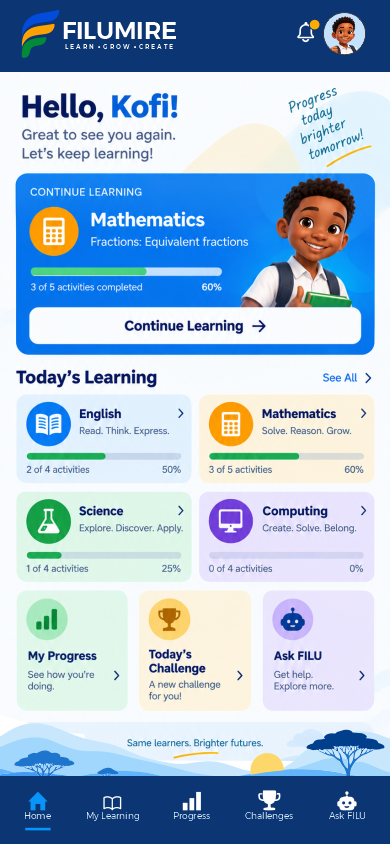
Built with purpose for African learners
FILUMIRE brings together curriculum, evidence of understanding and guided teaching. Its educational design puts African classrooms and families at the centre.

Made for Africa
Designed around national curricula, relatable cultural contexts and the realities of African classrooms and homes.

Personalised
The educational approach uses evidence to understand why a child struggles and choose suitable explanations and practice.

Effective
The goal is independent understanding that children can remember and apply in new situations.

Safety by design
Child safety, learner privacy and adult oversight are core design principles. Ask about current platform safeguards before enrolment.
Understanding why a child struggles
FILUMIRE’s approach looks beyond right and wrong answers to understand why, separating careless slips from prerequisite gaps and misconceptions.
Meet FILU: The Learning Companion
FILU is the instructional companion in the FILUMIRE learning approach: a friendly guide intended to explain ideas, ask questions and encourage independent thinking.
Guided Discovery, Not Just Answers
FILU’s intended role is to ask purposeful questions, offer progressive hints and use worked examples that help learners do their own thinking.
Bilingual Guidance
English and French are part of the language direction. Confirm the languages available for a particular lesson or pilot with the team.
Encouraging Independence
The teaching design calls for support to fade as confidence grows, helping children practise without hints.
The 5-Step Learning Sequence
The proposed teaching rhythm moves from explanation and supported practice to independent checks and reflection.
Conceptual Introduction
Clear, structured explanations using relatable representations, interactive visuals, and familiar examples.
Guided Application
Scaffolded questions where learners test their understanding with immediate, constructive feedback.
Contextual Problem Solving
Putting knowledge to work in practical community and classroom scenarios.
Low-Stakes Diagnosis
Unassisted verification that confirms independent capability without high-stakes test anxiety.
Retention & Synthesis
Spaced retrieval and transfer checks scheduled to ensure knowledge stays sharp over time.
An initial focus on four core subjects
The educational baseline is Ghana's NaCCA standards for Primary Basic 4, 5 and 6. Ask about the lessons and languages currently available.

Mathematics
Number operations, fractions, place value, geometry, and data interpretation with practical application.
- Number and Operations
- Fractions and Decimals
- Geometry and Shapes
- Measurement and Data

English Language
Grammar, syntax, vocabulary development, reading comprehension, and structured expression.
- Grammar and Usage
- Reading Comprehension
- Writing and Composition
- Vocabulary in Context

Integrated Science
Understanding living things, materials, earth systems, energy, and scientific observation.
- Diversity of Matter
- Cycles and Plants
- Systems in Nature
- Energy and Forces

Computing
Digital literacy, hardware parts, desktop navigation, data concepts, and responsible digital citizenship.
- Introduction to Computing
- Productivity Software
- Data Collection and Analysis
- Digital Safety
Designed for home and classroom
Education flourishes when learners, parents, and teachers share a common, transparent picture of progress.
For Families & Guardians
Empowering parents to support their children with clarity, not confusion.
- A focus on understanding what your child can do independently and where more practice would help.
- Practical home-learning ideas that do not require parents to be subject specialists.
- A calm learning approach that values encouragement, privacy and adult involvement.
For Teachers & School Leaders
Teacher-in-the-loop: An assistant that multiplies your instructional impact.
- An approach to identifying shared learning needs and supporting focused classroom teaching.
- Teachers remain central to interpreting evidence and choosing classroom priorities.
- Discuss device sharing, connectivity and the tools currently available before planning a pilot.
Designed Around Real Classroom Needs
Connectivity, device access, curriculum and language needs shape the design. Confirm implementation details for your setting before rollout.
Connectivity & Low-Bandwidth Needs
Intermittent connectivity is a key design concern. Offline sessions and synchronization must be confirmed for the version used in your pilot; they are not promised by this website.
Multi-Child & Shared Device Design
Shared phones, tablets and school labs are important use cases. Discuss current account and device support when arranging access.
Curriculum Alignment First
Ghana’s NaCCA Standards-Based Curriculum (Basic 4–6) is the initial educational reference. Availability is confirmed at subject and lesson level.
English & French Direction
This public website is available in English and French. Ask which languages are supported by the learning platform for your lesson or pilot.